
Information:
- Author: Kathleen S. Allen
- Genre: Historical, Horror, Thriller
- Page Count: 336
- Year Published: 2025
Read This If You Like:
- 19th Century Settings
- Women in medical fields
- Frankenstein retellings (kinda)
- Historical Thrillers
- Strange guys who you don’t know if they’re trustworthy or not
- Descents into darkness
- Books with journal entries and quotes
- Books that frame themselves with the big twists
- Uniquely colored covers
- Novels with no romance
Synopsis:
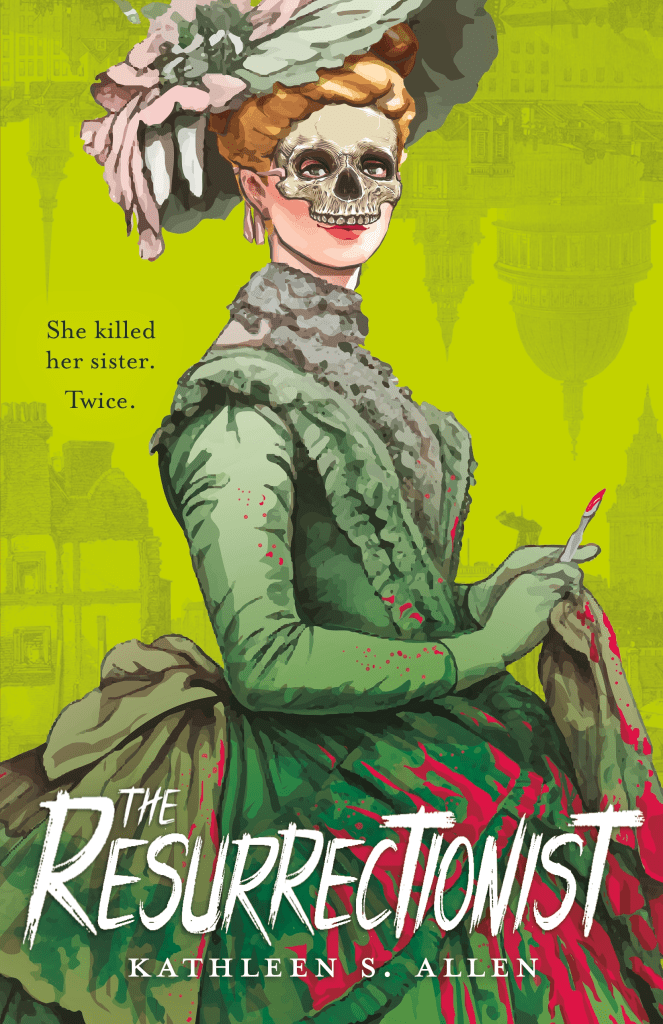
London, the 1800s. Dilly1 Rothbart, a young woman with a desire to go to medical college despite the barriers, and her twin sister, Deirdre, are dealing with the sudden death of their father. But at least the tragic events result in Dilly meeting Ben, the mysterious boy who has a connection to the medical society her father used to work at, and is able to get her into some classes. And that lecture, along with her father’s journal, is what leads Dilly to discover a shocking discovery- the dead can be resurrected. As Dilly gets closer with Ben and he brings her more opportunities, she finds herself delving deeper into a dark underworld of secrets. The only issue is that Deirdre is starting to get suspicious. And once Dilly gets closer to finally achieving a resurrection, she’ll have to question if she’s bringing life- or awakening a monster.
- It’s a nickname for Odile. Yes, I think there were better name options available. ↩︎
Review/Opinions:
I’m pretty sure we all have a specific genre or trope that makes you instantly put a book on your TBR when you see that it contains said trope. And I’m not talking about something widespread like enemies-to-lovers romances. I’m talking about tropes that are common, but wouldn’t be considered the first thing that comes to mind when thinking of a common book type, such as those Japanese coffee shop/bookstore cozy fantasies that are everywhere. Trust me, I know you have a hyper-specific book interest, just check your bookshelf and find a connection. For me, that niche is “19th century Historical thrillers with female protagonists who have a passion for practicing surgery/dissecting dead bodies”. It’s a bit off-putting of a niche, but I still consider Anatomy: A Love Story to be my first five-star YA novel, and I also loved Stalking Jack the Ripper (the sequel was kind of a letdown to me, sadly.) And then I decided to buy Kathleen S. Allen’s debut YA, The Resurrectionist, because…. it’s a 19th century historical thriller with a female protagonist who has a passion for practicing surgery/dissecting dead bodies. And sadly, this book didn’t extend the streak of absolute favorites that was happening with this subgenre. In fact, it was the first one of these novels where I found there was more than one flaw. I still liked The Resurrectionist, yet it had some issues- but to give the book some points, they were at least different issues then what I usually talk about.
I’ve written reviews where I’ve discussed underdeveloped characters, but I think this may be the first time I ever discussed a book having underdeveloped prose in some parts- specifically, sometimes in The Resurrectionist, the writing wasn’t as descriptive as it should’ve been. While I will definitely gush over a book if it has really vivid imagery and I’m able to feel immersed in the scene, I won’t get mad if a YA book has the simplest writing style imaginable and skims over some details. YA books are for teens after all, and teens most likely just want a good story. But when this book chose to speed through events and not describe things in depth, it started to bother me more. This isn’t because details such as the setting or how characters looked were underdeveloped; again, I don’t get mad if you skip over that stuff. It’s because during the most dramatic moments in the book, there was no description. Yep, during the moments made to add stakes, serve as major twists, and completely change the course of the novel, there was almost no description to allow us to sit with the moment and realize how tense it is. On principle, these were really good twists, but the lack of description and how the moment was over so quickly meant I felt no shock, just a feeling of, “Oh, a thing just happened.” I didn’t want full-on gore or anything, just some more focus on creating tension or showing the character’s reactions in the moment. The thing is, this book was good at describing the gory stuff. When we got to see Dilly actually dissecting bodies and focusing on the medical side of things, it was nicely described so you could get squeamish. So while there was some good description, it should’ve been emphasized more in some other scenes to add some extra impact.
That said, I did like most of the twists and the atmosphere in the story. This is a bit of a slower read at first- there’s a lot of meandering, and most of the early chapters are just Dilly getting opportunities that bring her closer to the actual resurrection part. But by page 150ish, things really pick up and we start to get a lot of darker elements. However, by the end the twists somehow managed to get repetitive. At some point, a few characters admit to have done something that I won’t give away, but is kind of easy to guess. And this happens 3-5 more times in the last 100 pages, with the exact same characters involved. Once you have the novel repeating the same twist so many times, it just happens to fall flat and get boring. It would’ve been better if these reveals happened only once, so they could feel more impactful and less like forced shock value. Also, this is one of those novels that is framed with the big final event being revealed first, before building up to it. I know some people aren’t a fan of that, because then it leads to the ending being more anticlimactic then it should be. I think the book would’ve been a bit better without this framing, only because so much other stuff turned out anticlimactic. But on its own, I actually liked revealing the final twist early, as it helped generate some early tension and could instantly hook a reader. I just didn’t like how said final twist was revealed right on the cover of the book. Good job marketing, you’ve been ruining YA twists for as long as I can remember.
In addition, it is quite clear that this novel was partly inspired by Frankenstein. The author directly mentions the classic book as a major inspiration in both the dedication and acknowledgments, but I thought it would just be a passive mention. However, there is a lot here that is taken from Frankenstein besides the whole resurrection plotline, down to a lecture scene that felt very similar to the one in the early chapters of Frankenstein, and a minor character named Victor Clerval (that one felt more like a tribute than copying though.) But there’s also a lot that diverges from Frankenstein, especially when you get into the twistier moments. To further discuss literary references in this book, all the chapters start with quotes from classic literature (not just Frankenstein, but also some other works such as Wuthering Heights and a few of Shakespeare’s sonnets), and although I skimmed over them a lot to focus on the actual story, I felt that they were a fun way to connect the book to the time period. The novel also started chapters with entries from Dilly’s journal, but I found those a bit less entertaining. At the start, I thought they were cool, because they were used to communicate major flashback moments. But once everything that needed a flashback was dealt with (this happened rather early into the book), the journal entries were mostly just repetitive blurbs where Dilly discusses her regret or briefly hints of what will happen three pages later. Otherwise, both the quotes and the journal entries helped to add some extra depth to the setting and characters, and I think they were fun ways to expand the book beyond the actual prose.
The last thing I want to discuss is the actual characters, and I thought they were all decent. This may not be noticeable if you haven’t read two books with a similar plot like I did, but Dilly was what I learned to expect for a book with this plot and setting- her interest in medical work drives most of her character, and she’s not afraid to get her hands dirty. I think the other stuff I’ve read with similar plotlines had better protagonists, mostly because I think those authors better portrayed how passionate they were. Meanwhile, it felt like Dilly didn’t really start making decisions for herself until halfway through the book, and before that, it felt like all of Dilly’s fascination was explored through other characters suggesting that she participates in something. The best part of her character development was when we got to see her inner conflict and when she made some tough decisions for herself. Most likely, her character was based off of Victor Frankenstein, but I still think Dilly was an interesting character to follow as she went further into the darkness. I also liked the other characters in the book too. It was clear that Ben was the type of character that was written so you could question if he was trustworthy or not, and it got a little excessive, but like Dilly, I enjoyed seeing how we got different sides of him overtime. (Minor spoiler that might please some people: this book doesn’t really have a romantic subplot.) Dilly’s sister, Deirdre, felt a bit annoying at first, but she went through some major changes that I found really intriguing. And then we have our side characters, which were a bit boring at times, but they all had a clear role for the plot. And while I found our main three characters slightly lacking, I wasn’t overly annoyed at any of them, and they all had multiple different layers to their personalities that made me enjoy following them.
There is no way that I would claim The Resurrectionist to be a copycat novel, even if it does resemble some other YA novels and even takes heavy inspiration from one of the most popular classics in the Horror genre. It actually has quite a bit of originality, especially with its approaches to the characters and its darker moments. However, there were definitely some parts where things were half-baked, mainly with the prose and a few of the big twists. That said, I found this book to be a fun read, partly because it had some tropes I liked, and partly because it was a nice story. And if you are like me and have a love for 19th century historical thrillers with female protagonists who have a passion for practicing surgery/dissecting dead bodies, you might also enjoy this book despite its flaws.


You must be logged in to post a comment.